AI projects
AI project

Jobfinder:
code fetches, Claude judges

My own tool for finding the right job postings. First I built an app that used AI itself. Then I let Claude do everything. Finally I split the work: the app fetches and remembers, and Claude evaluates the postings through an MCP server I built for the purpose.

  • Claude
  • MCP
  • Python
  • FastAPI
  • SQLite
  • Playwright
Try the demo
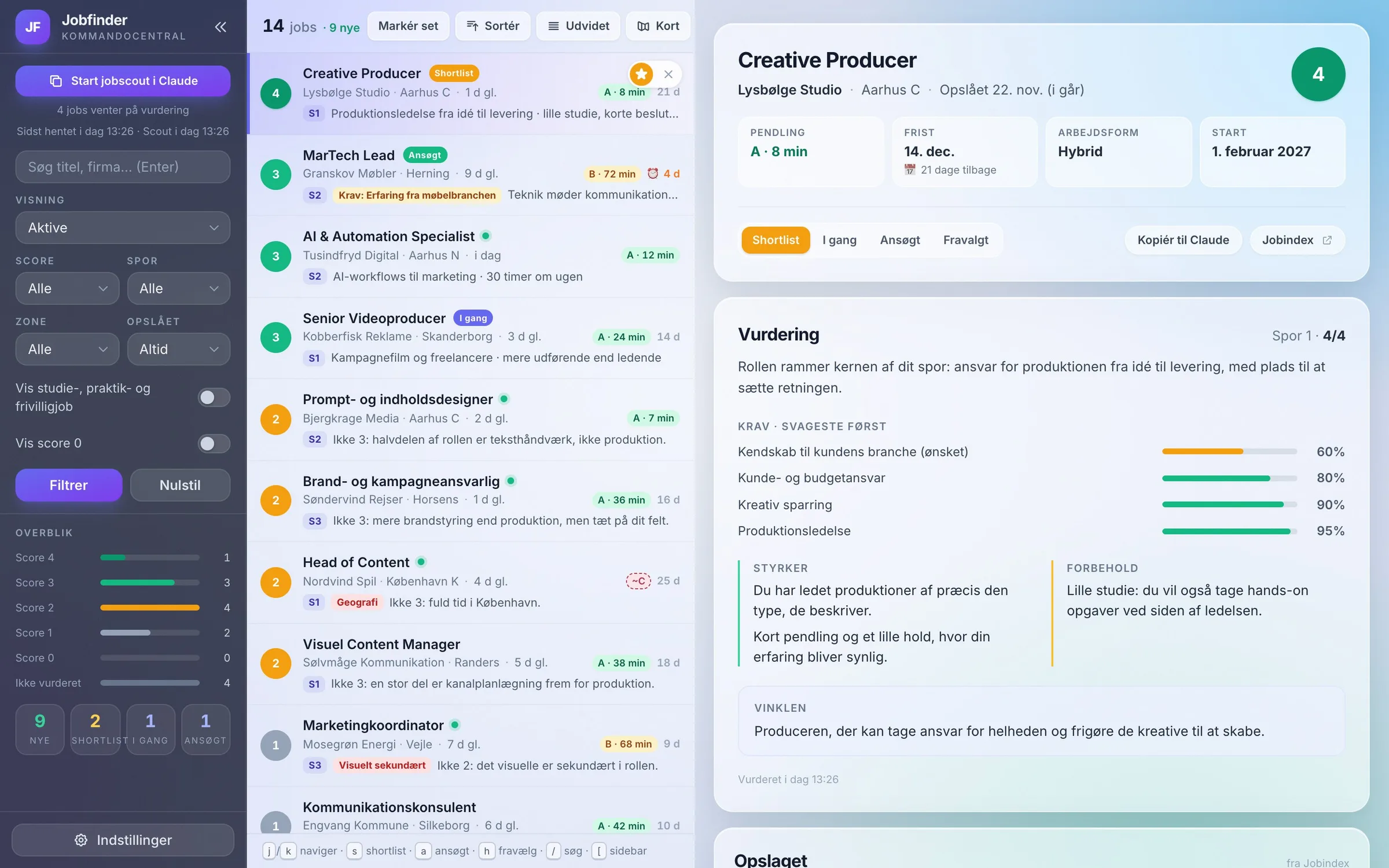
Jobfinder showing a list of jobs sorted by score and an open evaluation of the Creative Producer role
The real app: best matches first and an evaluation that explains itself. Companies and postings are fictional.
1 MCP server
13 tools that Claude uses
€0 in API
evaluation runs on my subscription
3 versions
before the division of labour was right
148 tests
so the code can be trusted
01 The problem

Too many postings. Too little time.

I search broadly: video and creative production, AI and communication. Most postings don't fit, and the right ones can't be spotted from the title.

I wanted a tool that reads the whole posting, judges it against my own criteria and remembers what I have seen and applied for.

The whole posting
The evaluation has to rest on the full text, not the title.
Data stays with me
Jobs and evaluations live locally on my Mac.
No API bill
It has to run several times a day without a cost per evaluation.
02 The story

Three versions before the division of labour was right

Jobfinder was not built in one go. The first idea didn't hold, the second was better but missed something. The third combines the best of both.

Version 1
Stalled

An app that uses AI itself

I built a web app that fetched job postings and had a language model evaluate them.

The app fetched postings from Jobindex, stored them in a database and sent each one to a language model with a fixed prompt. Back came a score and a short analysis. It could also calculate driving time with Google Maps, filter and archive.

Much of it worked well. Especially the scraper, which checks that it got the actual posting and not an error page, and a database with a status on every job.

Fetches
The app
Judges
A language model over an API, with a fixed prompt
Remembers
The app
Cost
Paid per evaluation

Why it stalled: An API is billed per call, so every posting cost money. The model and prompt were locked into the code, while the Claude apps kept gaining better models, memory and tools my app could not use.
Version 2
No memory

Claude does everything

Then I tried the opposite: no app, only Claude.

I gathered my criteria in a Claude project: three search tracks, a score scale from 0 to 4, commute zones and dealbreakers. Claude remembered what I had applied for and used the browser itself to go through Jobindex, LinkedIn and Jobnet. Finally I packaged it all as a skill that handles a run from search to application.

The evaluations got much better. Claude read the whole posting with my instructions and history at hand. And it ran on the Claude subscription I already pay for, so an extra posting cost nothing.

Fetches
Claude, in the browser
Judges
Claude, with my instructions and memory
Remembers
Nothing between runs
Cost
My subscription

Why it wasn't enough: I wanted to run it every day. But the agent remembered nothing between runs and produced a new overview each time, with the same jobs again and again. And having an AI page through a job list used a lot of the subscription on something purely mechanical.

Version 3
The solution I use today

The app fetches and remembers, Claude judges

The answer was to split the work by what each part does best.

I revived the app from version 1 but switched its own AI off. It fetches Jobindex and remembers everything: jobs, evaluations and my status on each job. On top I built an MCP server, so Claude can read and write straight into the app's database.

Code fetches Jobindex because the site is public and already contains structured data. That is mechanical work code does fast and for free. Claude fetches LinkedIn and Jobnet because LinkedIn needs a login and Jobnet only answers in a real browser. Claude uses my own browser, where I am already logged in.

Evaluation stays with Claude on my subscription. It costs nothing extra per posting, the model updates itself, and Claude has my instructions and memory at hand. A fixed prompt in an app can't do that.

Fetches
Code: Jobindex. Claude: LinkedIn and Jobnet
Judges
Claude, over MCP
Remembers
The app, locally on my Mac
Cost
My subscription

The result: Code does the mechanical part, Claude the part that takes judgement, and everything lands in one place where I can review and choose.

03 Architecture

Build the bridge, not a new app

Jobfinder runs locally on my Mac. I gave it an MCP server, so Claude can use it as a tool: fetch jobs, read postings and save evaluations.

Jobindexpublic job search
code fetches
jobfinderlocally on my Macthe app from version 1
  • ScraperJobindex, validated text
  • SQLitejobs, evaluations, status
  • Web appwhere I review and choose
  • MCP server13 tools for Claude
MCPreads and writes
Claudethe desktop appmy subscription
  • Skill: jobscoutthe procedure
  • Project instructionstracks, score and zones
  • Memorywhat I have applied for
  • BrowserLinkedIn and Jobnet
Claude reads
LinkedIn · Jobnetneed a login or a browser
A Reuse

Reuse what works

The app from version 1 already had a scraper, a database and an overview. I switched its AI off and built only what was missing.

B MCP

One bridge instead of a new app

MCP is the standard way to give an AI tools. A small server was enough, and Claude can now use jobfinder from both desktop and cloud.

C Cost

Data at home, no bill

Claude evaluates on my subscription with the newest model. All data stays on my machine.

Dropped: a new app built inside Claude. Faster to make, but the data would live with a third party, and everything that already worked would have to be built again.

04 Try it

Press Run jobscout

Watch jobfinder fetch new postings while Claude evaluates them one by one. Click a job, change its status, or open the map.

Jobfinder · demo
Live: Claude's calls to jobfinder over MCP
  1. This shows what Claude calls in jobfinder when you press Run jobscout →

The demo runs in your browser with fictional jobs and replays the real tool calls. The maps load from OpenStreetMap only when they come into view.

05 How I think

Judgement before code

AI writes most of the code. My job is to understand the problem, set the direction and make sure the result holds up.

A Division

Code for the precise, AI for the hard

Fetching a job list is mechanical, so code does it for free. Reading a posting and judging it against my criteria takes judgement, so Claude does it.

B Clear frame

Write the goal down

Every decision is in a log with its reason and the alternatives dropped. And the rules for how Claude fills in an evaluation live in the MCP server next to the code. When I change a field, Claude gets the new rule at once.

C Trust

Mistakes must be visible

Duplicates are flagged instead of merged. The scraper checks itself against Jobindex' own count. A guess from the AI is shown as a guess.

06 Under the hood

The real app

Commute, not kilometres

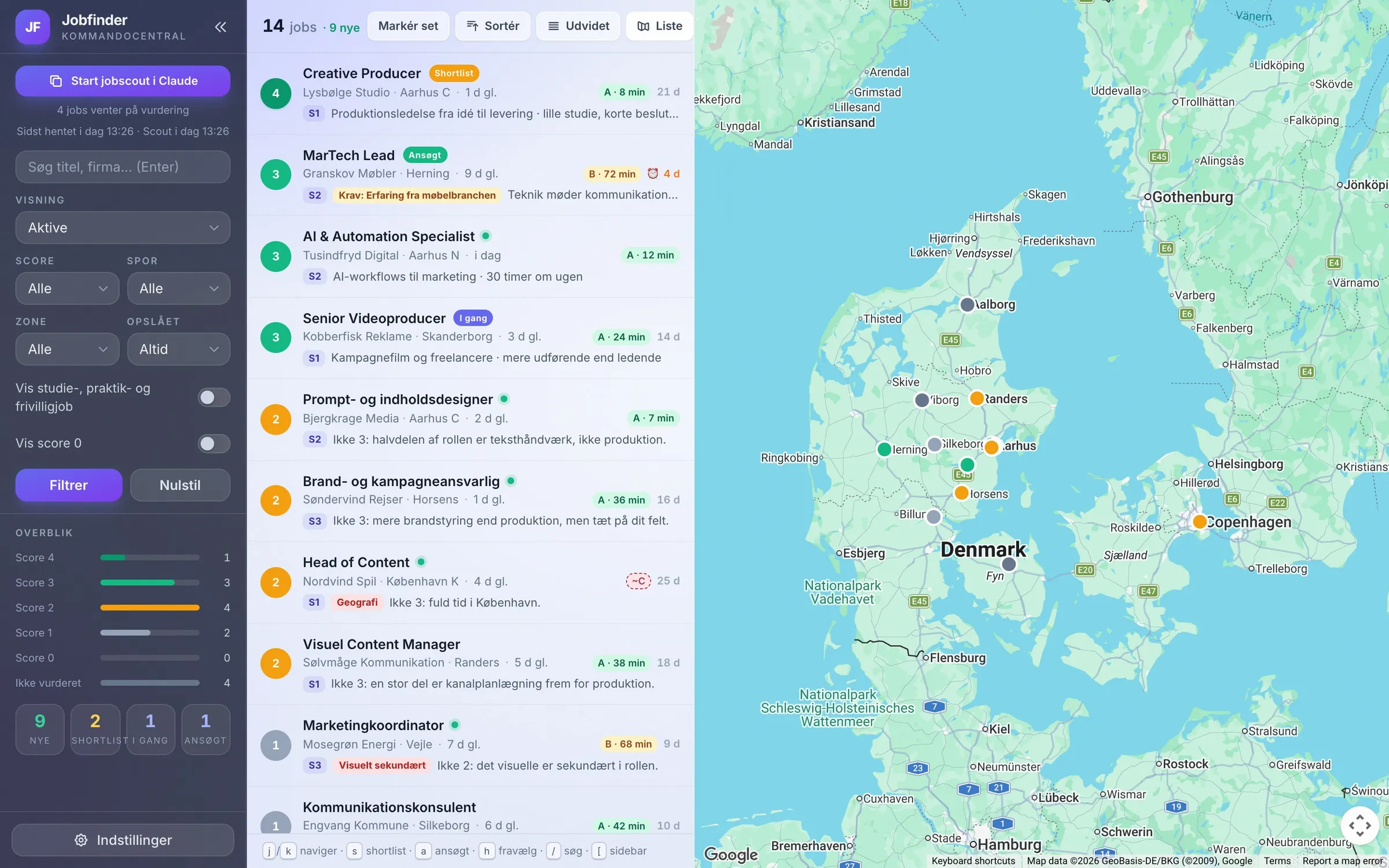
Driving time is calculated with the Google Routes API to the actual workplace, and the zone is derived in code. The map shows every job, coloured by score.

Jobfinder in map view over Denmark, with jobs as dots coloured by score
The map view in the app (interface in Danish). Companies and postings are fictional.

13 tools for Claude

Each tool explains how it should be used. Wrong values are rejected with an error Claude can fix, instead of ending up in the database.

jobfinder · MCP server · 13 tools
Run
get_status()
last run, counts per status, health
start_run(kind)
light or full run
finish_run(run_id)
routes commutes and closes the run
Fetch
scrape_jobindex_now()
fetches Jobindex in the background
get_run(run_id)
follow the scrape
upsert_job · upsert_jobs
finds from LinkedIn and Jobnet, deduplicated
Read
list_jobs(…)
e.g. every job awaiting evaluation
get_job(id)
the full posting as text
Save
save_evaluation(id, …)
score, rationale, requirements, strengths, reservations, angle
save_triage([…])
score 0 in bulk
set_work_address(id, …)
workplace address, possibly AI-assessed
set_user_status(id, …)
shortlist, in progress, applied, dismissed
Every run starts with get_status and ends with finish_run.
Agent
  • Claude
  • MCP (Python SDK)
  • skill: jobscout
Code
  • Python
  • FastAPI
  • SQLite
  • Playwright
Data
  • Jobindex
  • LinkedIn
  • Jobnet
  • Google Routes API
Quality
  • 148 tests
  • demo mode with fictional data
07 Result

Faster to the right jobs

Jobscout can run several times a day. I open the app, see the new jobs with an evaluation and decide.

What matters most here is not the technology but the division of labour. And it holds far beyond job hunting.

Code fetches. Claude judges. I decide.
Contact

Got a production or a role where this fits?

I live near Aarhus and am happy to work hybrid. Drop me an email and let's talk.